
Honey Biotics
For some people, skin conditions go beyond irritation; they become long-term, unresolved issues where treatments stop working and options start to narrow.
In 2005, Lindsay Goulter found himself at that point. After more than 18 months of unsuccessful treatment for an antibiotic-resistant MRSA infection, compounded by a diabetic ulcer, the outlook shifted from recovery to amputation. With no viable alternatives left, he turned to something unexpected: soaking socks in high-strength Manuka honey and wearing them over the infected area. Within days, the redness began to subside, and over the following weeks, the wound started to heal. His leg was saved.
That moment would go on to shape Honey Biotics; an Australian skincare brand built on the therapeutic potential of Manuka honey.
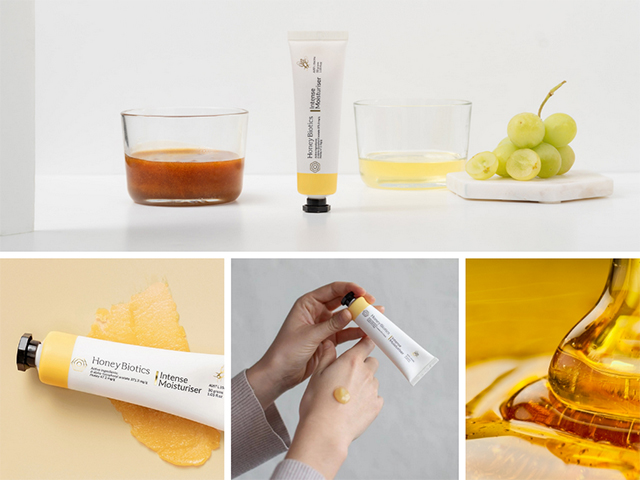
At the centre of the range is the Intense Moisturiser, a TGA-listed, steroid-free balm powered by MGO 570+ Manuka Honey, known for its antibacterial, anti-inflammatory, and wound-healing properties. Designed to treat eczema, psoriasis, dermatitis, and chronic dryness, it supports barrier repair and long-term skin health without the risks associated with prolonged steroid use.
Formulated with 100% active ingredients including natural vitamin E, jojoba oil, shea butter, and beeswax, the balm delivers targeted relief while maintaining skin integrity, making it suitable for sensitive and compromised skin across all ages, and endorsed by the Eczema Association of Australasia.
To better understand how that moment evolved into a brand grounded in both lived experience and clinical credibility, we spoke with Matthew Boyle, who now leads Honey Biotics. In the Q&A below, he shares the origins of the formulation, the role of Manuka honey in modern skincare, and how the brand continues to support those navigating persistent and often treatment-resistant skin concerns.
1. Can you take us back to the beginning. What was happening in your grandfather's life at the time of his diagnosis, and how serious was the situation?
This started towards the end of 2005. I was still quite young at the time, but it's something that's stayed with me because of how drawn out and uncertain it became. My granddad, Lyndsay, had been dealing with an infection for a long time, and it wasn't improving, it was persistent and getting worse. He was in and out of hospital constantly, and over time it became clear this wasn't something routine or manageable. There was a shift from trying to treat it, to questioning whether it could be controlled at all, and even as a kid you could feel that change in tone; it had become very serious.
2. What exactly were doctors telling him about the infection, and at what point did amputation become a real possibility?
Initially, the focus was on managing the infection through standard treatment, debridement, antibiotics, and ongoing hospital care, but after repeated attempts without success, the conversation shifted. It stopped being about how to heal it and became about how to contain it, and that's when amputation was introduced as the only viable option to prevent it from spreading further. It wasn't positioned as a possibility, but as a necessity, which made it incredibly confronting for him and for the family.
3. Do you know what type of infection he was dealing with, and why it was resistant to antibiotics?
It was an MRSA staph infection, which is known for being highly resistant to antibiotics, and in his case it was compounded by a diabetic ulcer, which made healing significantly more difficult. You've essentially got a situation where the body's ability to repair itself is already compromised, and the infection itself is highly adaptive, so conventional treatments just weren't effective in controlling it over a sustained period of time.
4. How long had Lyndsay been undergoing antibiotic treatment, and what was the impact both physically and emotionally when it wasn't working?
He underwent various antibiotic treatments over roughly 18 months, including intravenous antibiotics in hospital, and physically it took a toll, but I think the emotional impact was even greater. Being told repeatedly that nothing was working and that amputation was the likely outcome is something most people would struggle to accept, but he was a very determined and stubborn person, and in this case that mindset worked in his favour because he refused to see that as the only ending.
5. What led him to consider Manuka honey as an alternative approach at that moment?
I think it was a combination of desperation and determination. When you're told there are no more options, you naturally start looking beyond conventional paths, and he was someone who believed there was always another way if you were willing to keep searching. At that point, he felt like he had nothing to lose, so trying something unconventional didn't feel like a risk; it felt like the only thing left to explore.
6. Was this something he had prior knowledge of, or did someone introduce the idea to him?
He had friends in the honey industry who initially suggested it, but from there he really took ownership of understanding it himself. He had a genuine interest in alternative medicine and different cultural approaches to healing, so he spent time researching the properties of Manuka honey and how it had been used historically. At that point, the science wasn't as widely recognised as it is today, but there was enough evidence for him to believe it was worth trying.
7. Can you talk us through exactly what he did. How was the Manuka honey applied, and over what period of time?
It's definitely not conventional, but he essentially soaked fresh pairs of socks in Manuka honey and wore them so that it stayed in constant contact with the infected area. He committed to doing this consistently over about a week, not as a one-off attempt, but as something he fully leaned into because he believed it might work.
8. At what point did he start to see improvement, and how did that compare to the results he'd been seeing with conventional treatment?
He started noticing changes within about three days, particularly a reduction in redness, which was significant given there had been little to no improvement over the previous 18 months. Over the following weeks, the ulcer began to dry out and gradually heal, which was a completely different trajectory to what he had experienced with conventional treatments.
9. How did his medical team respond to his recovery?
They were surprised and understandably cautious, but at the same time they couldn't ignore what they were seeing. There was still some scepticism around how it had happened, but the outcome spoke for itself, and ultimately they agreed that amputation was no longer necessary and moved to monitoring the situation instead.
10. What do you think was going through Lyndsay's mind during this time, particularly when facing the possibility of losing his leg?
I think there would have been a mix of fear and determination, but also a refusal to accept that outcome as inevitable. He wasn't someone who gave up easily, especially when it came to something as significant as his health, and when it started to work, I imagine there was a sense of relief but also a quiet confidence that trusting his instincts had paid off.
11. How did this experience shape his outlook on health, healing, and conventional versus alternative treatments?
He was always very focused on helping others and had spent a lot of his life supporting communities and developing countries in need, so this experience gave him something tangible that could do that in a very direct way. It didn't turn him away from conventional medicine, but it reinforced the idea that there can be other solutions worth exploring, particularly when traditional approaches aren't delivering results.
12. At what point did the idea for Honey Biotics begin to take shape following his recovery?
It started from a very practical place. We wanted to recreate what had worked for him, but in a way that was usable, consistent, and safe for other people. The original approach was obviously unconventional, so the focus became how to translate that experience into something more refined without losing what made it effective. That meant working with high-grade Manuka honey, but also thinking carefully about how to support it with other ingredients that could improve skin barrier function, hydration, and overall skin resilience.
13. How did he go from a personal remedy to developing a formulation that could be used by others?
As more people heard about what had happened, there was a growing demand from friends, family, and eventually customers at local markets who were dealing with similar skin issues; things like eczema, dermatitis, psoriasis, and chronic dryness. That's when the formulation started to evolve more intentionally, not just around Manuka honey, but incorporating complementary ingredients like natural vitamin E, jojoba oil, and shea butter to enhance absorption, lock in moisture, and support repair. It became less about a single ingredient and more about creating a complete, functional treatment.
14. Who was involved in translating his experience into a clinically viable product?
As the product gained traction and we continued hearing consistent results from customers, it became clear that we needed to validate it properly. That's what led us to work towards TGA registration, ensuring the formulation met strict standards for safety and efficacy. Today, it's a TGA-listed product and recognised by organisations like the Eczema Association of Australia, which was an important step in moving from a personal story to something people could trust as a legitimate therapeutic option.
15. Lyndsay's story remains such a powerful part of the brand today. How is his legacy carried through in the business now?
His legacy is really carried through in the intent behind the product. We're not trying to create something cosmetic or trend-driven; we're focused on helping people who are dealing with real, often persistent skin concerns. That's why the formulation is still centred around high-strength MGO 570+ Manuka honey, supported by botanicals that actively contribute to healing, hydration, and barrier repair, rather than fillers or unnecessary additives. It's about staying true to what worked, but continuing to refine it in a way that delivers consistent, reliable results.
16. Who is currently leading the brand, and how closely are they connected to Lyndsay's original journey?
Myself and my brother Christopher are leading the brand today, and while we were young at the time, Grandad was living with us, so we experienced that period very closely. That's shaped how we approach the business. We're not removed from the story, we saw it firsthand, which is why there's a strong sense of responsibility to maintain the integrity of what he started.
17. How often do you reflect on or share his story internally and with customers today?
Quite often, but always with a level of care because we understand how significant that story is. For people dealing with chronic skin conditions, there's often a sense of frustration and fatigue, and while we're careful not to overstate outcomes, the product is now used across a wide range of concerns; from eczema and psoriasis through to wounds, burns, and general skin repair. Hearing from customers regularly who've experienced real improvements reinforces that this isn't just a story. It's something that continues to have a practical impact.
18. Can you walk us through the key milestones; from his recovery through to the brand's development and where Honey Biotics is today?
The product was officially released in 2012, following years of refining the formulation to ensure it could deliver consistent results beyond that original experience. Lyndsay passed away in 2015, so he didn't get to see how far it would go, but the foundation was there. I took over in 2019 with a focus on scaling the brand while maintaining its therapeutic positioning, and today it's grown significantly; we're selling a tube every three minutes. What's important, though, is that the core hasn't changed. It's still a TGA-listed, steroid-free formulation designed to support skin healing in a way that's both effective and safe for long-term use.
19. Are there any moments since then that feel particularly significant in honouring what Lyndsay started?
For me, it always comes back to the customer stories, because that's the most direct reflection of what he started. Hearing from people who've struggled for years and have finally found something that helps is what makes it feel meaningful and keeps everything aligned with his intent.
20. Why do you think Lyndsay's story continues to resonate so strongly with people dealing with chronic or unresolved skin conditions?
It resonates because it reflects a situation that many people can relate to. Not necessarily the same severity, but the experience of trying multiple treatments without success. His story represents a turning point where something different made a meaningful impact, and that gives people a sense of possibility, particularly when they're feeling stuck or frustrated with their skin.
21. What does his experience say about the role of nature-based solutions alongside modern medicine today?
I think it reinforces that the two don't need to be in opposition. Modern medicine is critical, but there are situations where nature-based solutions can play a complementary role, particularly when they're supported by evidence and formulated properly.
MORE
FEMALE.COM.AU
CONTACT US
FOLLOW US ON