
Bugonia - Starring Emma Stone and Jesse Plemons
Synopsis
Two conspiracy obsessed young men kidnap the high-powered CEO of a major company, convinced that she is an alien intent on destroying planet Earth.
About the Film
From visionary director Yorgos Lanthimos comes "Bugonia," an explosive psychological thriller that offers a pitch-black comic window into our modern age of madness.
Provocative and subversive, the film follows two conspiracy obsessed young men as they burst out of their online rabbit holes and kidnap Michelle, a high-powered CEO they believe to be an alien who has come to destroy us. After the pair chain her in a basement and come face-to-face with the enemy, the two sides " the tinfoil-hat basement dwellers and the steely, soulless corporate executive " soon find themselves pitched in a battle as viscerally unpredictable as it is unexpectedly moving.
Anchored by powerhouse performances from Jesse Plemons and Emma Stone and newcomer Aidan Delbis, along with a devilishly sharp script from Will Tracy, Lanthimos constructs an audaciously original portrait of what it means to laugh, cry, and recoil in the fate of humanity.
ABOUT THE PRODUCTION
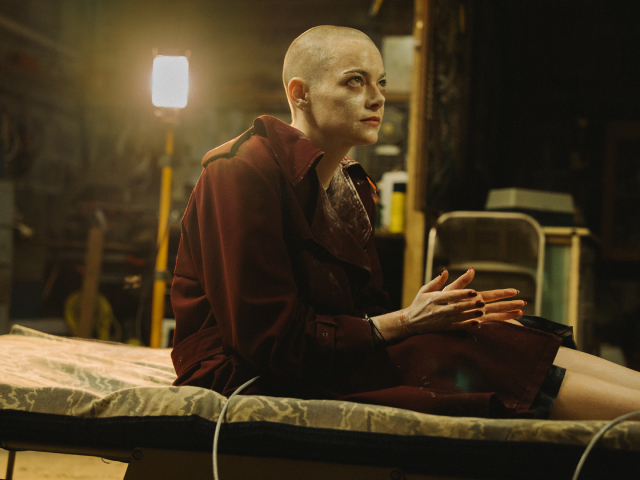
In "Bugonia," our age of conspiracies and paranoia, of disconnect and dread has come home to roost in thrilling, riotously unpredictable fashion. Convinced that Michelle (Emma Stone), the formidable and ruthless CEO of a pharmaceutical company, is an alien plotting to destroy Earth, two conspiracy-driven cousins kidnap her and chain her in their basement. Led by his seemingly erratic, dark-web ideas, Teddy (Jesse Plemons), the ringleader of the operation, has Don (Aidan Delbis) shave Michelle's head and slather her in anti-alien lotion, before confronting her about a supposed plan for planetary armageddon that involves bee extinction (the film's title refers to an ancient Greek belief in the birth of bees from dead cows) and a lunar eclipse.
As an ostensible doomsday clock ticks on, Stone and Plemons go toe-to-toe in raw, unyielding performances suited for what increasingly feels like a cosmic battle for the fate of the world " or at least for the fate of our shared sense of reality. Exploring the fringes of human behavior on lush VistaVision, the film offers an immersive and viscerally charged capsule of contemporary life, plunging us into that familiar, maddening sense of what it feels like to be alive today.
"In the world that we live in now, people live in certain bubbles that have been enhanced by technology," Lanthimos says. "Having certain ideas about people is reinforced depending on which bubble you live in, creating this big chasm between people. I wanted to challenge the viewer about the things that we're very certain about, the judgment calls that you make about certain kinds of people. It's a very interesting reflection of our society and the conflict in our contemporary world."
Even as Michelle tries to expose Teddy and Don's harebrained logic, our preconceived ideas about either side slowly morph into thornier revelations as much about ourselves as the trio in the basement.
"It has that sort of microcosmic quality," says Stone, who produced the film with Lanthimos in their fifth project together. "There's a sort of insanity and a commentary in the midst of a really small environment, which I think Yorgos tends to be drawn to. We're in a basement, and it's really just people talking to each other a lot of the time, having perspectives that feel maybe incorrect or twisted. But they reveal these different versions of humanity and what can happen in a downward spiral of convincing yourself of something."
That downward spiral might be about us all as much as it is about Teddy and Don, but the film is far too irreverent and unpredictable, Plemons notes, to start preaching to its audience. "The tone of it is so wild and varying " it's so funny and so tragic, and the way into these very big conversations is so left-field and unexpected," says Plemons. "It's a really strange but honest portrait of the times we're living in, how confusing and absurd it all is."
Stone agrees, noting the singularly surreal sense of humor nestled within the film's often "deeply sad elements." "Bugonia" is, in other words, the kind of horrifically funny " or hilariously horrific " film about our global doom times that only Lanthimos could make.
"While the film is in many ways a comedy, it's much more layered and textured than that and goes to all these places that you don't expect it to go, and that's Yorgos's happy place," says producer Ed Guiney. "He's a master of tonal dexterity: he can pivot from high comedy to tragedy in one nanosecond."
The film's origin story, though, can be traced to CJ ENM, who saw the potential for an English adaptation of "Save the Green Planet". "We began assembling the ideal team"inviting, one by one, Ari Aster and Lars Knusden, who deeply understood and admired the essence of the original as a devoted fan; Will Tracy, who could infuse the story with the zeitgeist of our times; and Yorgos Lanthimos, one of the rare filmmakers capable of pushing such a daring concept to its limits with his singular vision. We were fortunate to bring together this remarkable combination of talents," says producer Jerry Kyoungboum Ko of CJ ENM.
When Aster " who produced the film alongside Knudsen, Guiney, Andrew Lowe, Stone, Lanthimos and CJ ENM " told Will Tracy to watch "Save the Green Planet" a few years back, he gave the veteran screenwriter little context. Tracy had never heard of the obscure Korean sci-fi comedy and could barely even track down a faithfully translated copy. But, Aster indicated, there was the seed of another story in there " one about us, now.
"Within twenty minutes of watching it, I knew what he was talking about," Tracy recalls. "I knew that there was something in this Korean film from 2003 that could be adapted in a very exciting way for a contemporary Anglo-American context."
Amid the apocalyptic dread of the pandemic's early days, Tracy wrote a boldly explosive reimagining of the story in a frenzied quarantine haze.
"We were locked-down, and I was probably losing my mind a little bit in this little apartment in Brooklyn," he says. "I wrote it in about three weeks, and I've tried not to analyze it too much, but I'm sure something in that atmosphere made its way into the script – that claustrophobic feeling that I don't think I would have been able to write if not in those circumstances."
"It was one of the best scripts I've ever read: darkly funny, but with great pathos, drama, story, and fantastic characters," says Lowe.
That script ended up in the hands of Lanthimos, a filmmaker whose singularly ambitious vision Aster knew could bring Tracy's new story to life. "Yorgos has such a personal, idiosyncratic style, I knew he would find a new visual and tonal language for the story," Aster recalls. "It would be a totally new interpretation, as Will's script had already become in the development process." Miky Lee, who also developed and produced the film through CJ ENM explains, "Rooted in the DNA of Korean cinema, it has been transformed into something daring and imaginative through the vision of Yorgos Lanthimos and Will Tracy, and vividly brought to life by the brilliance of Emma Stone, Jesse Plemons, and the entire 'Bugonia' team. It serves as a reminder that authentic stories can evolve into new forms and find resonance with audiences in profound and unexpected ways."
When Lanthimos read the script, the acclaimed auteur could immediately see in it a vision for a darkly comic provocation: a new kind of psychological thriller built for the big screen " and for the absurdism of our modern moment. "It was such a quick read," Lanthimos says of Tracy's script. "It was entertaining. It was complex. It felt very relevant. It was contemporary."
That idiosyncratic sensibility is perhaps never more poignant than here, in what might be considered Lanthimos's most anarchic and profoundly humanistic work yet. It is also one that begs to be experienced in theaters: to laugh, cry, groan, and recoil, among one another.
"Most films should be enjoyed like that, in a cinema with other people. It's a communal experience, but especially this film, the way it's filmed on VistaVision, a beautiful format, and the sound design that Johnnie Burn has done, along with Jerskin Fendrix's score," Lanthimos says. "It's just a very full and dramatic experience, both in its hilarity and its horror, that can only be experienced fully in a cinema."
The Basement
Teddy's basement in "Bugonia," says Lanthimos, is a contained environment that operates almost like a twisted science experiment, throwing lab rats into a pool containing all of the anxieties, fears, and farcical realities of modern life. But that experiment soon becomes a kind of fun-house mirror reflection, not only of Teddy, Don, and Michelle " i.e. the lab rats in question " but also us as viewers.
"By limiting the environment in which this conflict takes place, we enhance the focus on the characters and what they represent, but also reveal that what appears obvious in the beginning might not be true," Lanthimos says. "The film slowly reveals layers and layers of complexity in all of the characters, making whoever is watching the film rethink the biases they might have."
That might be most apparent in our understanding of someone like Teddy. In preparation for his role, Jesse Plemons went down his own rabbit holes, reading about our age of conspiracy paranoia in books like Naomi Klein's "Doppelgänger."
"One thing that Klein said that really makes sense is, with a lot of people that migrate towards some conspiracy theory, the seed of that fear is correct," Plemons says. "The idea that we are being manipulated, our data is being mined, these forces of evil and this sort of capitalist machine are trying to control our lives " if you have all these valid feelings, where can you go? Really the only people that are really talking about it are these fringe conspiracy theorist podcasters. But the seed of the feeling is correct."
This complex dynamic strikes at the heart of the prickly complexity of "Bugonia." Forceful in his beliefs and methods, Teddy may appear to be tinfoil-hat lunatic, but the anger and fear that he is motivated by " capitalist exploitation, ecological disaster, and a sense that, as he puts it, "nobody gives a fuck about us" " is starkly real.
His motivations are only complicated by a darker history that gradually, and terrifyingly, boils to the surface. "He's been dealt a pretty shitty hand in life," says Plemons. "He's got a mother that was a part of this trial opioid drug treatment that left her in a coma, and he just desperately wants to help, but he's gotten a little lost along the way."
In his mother's house in the American heartland " where, Stone notes, things have been suspended in time since Teddy's mother left " Teddy's time outside of his factory job are spent beekeeping, researching the true order of the universe, and training with Don to prevent a takeover from an alien species. He has cycled through every fringe political and conspiracy subgroup out there before leeching onto this theory about Andromedan control. But all of his deep dives into rabbit holes has perhaps been a defense against the tide of grief and a deep sense of futility in a society that seems to have used his family and cast them aside.
"He was just left to try to sort through all these feelings of absolute powerlessness and hopelessness," Plemons says. "All this bubbling inside him " where do I put this? How do I take control over this awful circumstance that I've been left with? This belief that he's landed on has given him a sense of power and purpose and a way to sort these things, even in an indirect sort of way. Anytime the past is brought up, he always takes it back to this mission."
Plemons sees in Teddy what is, if a more extreme version, a similarly tragic reality that exists for many in an era of division and disconnect. "So many people feel in the world today that they're just completely overlooked and forgotten," he notes. "They're just sort of being blown around by the powers that be."
In "Bugonia," Michelle appears to be the soulless manifestation of those powers. The powerful CEO of a pharmaceutical bioengineering company, she is ruthlessly in control of everything and everyone in her orbit. "Michelle's natural way is in being a CEO and being in charge," Stone says. "She tries instantly to become that even in the midst of an insane situation with Teddy and Don after she's kidnapped."
Whether she is indeed an alien overlord or a billionaire executive, she is "a kind of life-sucking force that's trying to take something from the Earth," says Stavros Halkios, who plays a local cop who becomes embroiled in Teddy's scheme.
At least, that's the initial impression one might project onto her. "Then, scene by scene, you start to understand her more," says Lanthimos. "You watch her reveal " or try to conceal " all these other layers."
The more we get a sense of Michelle as an actual person " rather than what she simply represents as a figure of power " who feels pain and has her own thoughts, the more Don comes to squirm at what he and Teddy are doing. If his theory and the mission at-hand have offered Teddy a kind of control in his life, he only wants to pass that sense of empowerment onto Don, his younger cousin who has also lost his family.
"He's a kind of a shy and awkward person, but also at the same time shows himself to be, in spite of that, really brave and strong," Delbis says of Don.
In a way, he notes, Don is almost unwittingly roped into this whole situation, a sensitive soul who is thrust into violent extremes simply out of a love for the only person he has left. "Teddy is kind of the last person in the whole world that Don really feels like he can count on, that cares about him," he says. "And Teddy sees Don arguably in the same way."
Plemons concurs. "It's really tragic and really beautiful, their relationship " they're all each other has," he says. But eventually, as the mission reaches its extremes, Don chafes against Teddy's beliefs and what they're willing to do to Michelle to get the truth out of her. Ultimately, his ambivalence becomes a placeholder for us.
"Don is the soul of the film and the moral compass," Lanthimos says. "He represents the audience: He's always conflicted. He always questions things, but he's also very loyal to Teddy, and he doesn't want to go against him. But there's something inside him that tells him what they're doing might not be the right thing."
Casting
Working on her fifth project with the director, Stone compares her partnership with Lanthimos, both as an actress and producer, to that of a theater company.
"We have this great working relationship and the crew and parts of the cast are so often the same " there's so many people that we get to work with again and again," she says. "It really just does feel like this family situation where you're making pretty challenging stuff, but in a way that feels safe and good and tight-knit. It's a really rare thing to find and almost impossible to duplicate a scenario like that."
But perhaps most of all, she finds an alignment with him in the material they gravitate toward. With "Bugonia," she saw immediately the same thing that Lanthimos saw, a kind of twisted, funny, and horrifying mirror of the world today.
"I sent the script to Emma immediately after I read it," Lanthimos recalls. "I trust her opinion and instincts. My initial reaction was: I love this, but is this the right thing for me to do and for the both of us to do? She jumped on it immediately and helped me make the decision to take it on with the entire team."
Partly an output of their now seasoned artistic partnership, Lanthimos largely left Stone to find her own register of Michelle, a layered role that presented a new kind of challenge for the Oscar-winning star."It's a very difficult role, not only physically, because she goes through a lot, but also because she's portraying a woman who you get a certain idea about from the beginning and has to maintain this balance in how she slowly reveals aspects of herself," Lanthimos says.
As Michelle negotiates her release with Teddy and Don, and the hours become days, the power dynamic appears to constantly shift. Michelle, in turn, seems to transform, the seemingly shark-like businesswoman changing tactics and divulging secrets that we're not ever quite sure are true.
"It's very complex trying to get out of the situation that she's in, so she finds herself lying about things and then telling the truth, but nobody really realizes what the truth is exactly," Lanthimos says. "Walking that line between what is true and what is false, and what is her real character and what's a performance " it's a very complex, very delicate balance. And she's just incredible in managing exactly that. Her performance is so nuanced and so complicated."
"She's so committed and open to play around and explore," Plemons says. "She's just so talented on so many different fronts physically and technically, while also just being completely free to try things."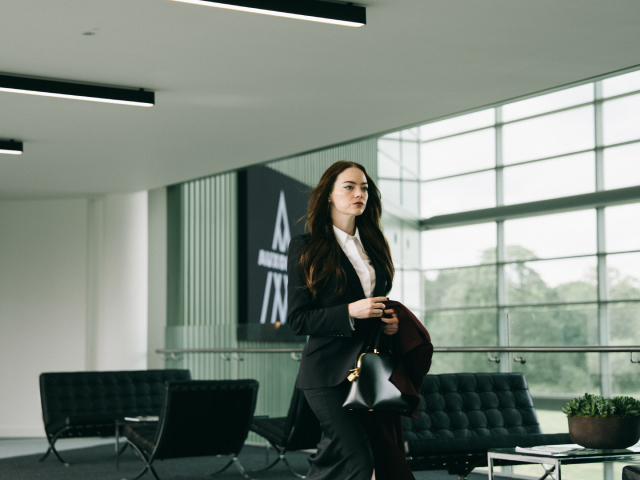
Plemons had been eager to work again with Lanthimos after starring in the director's 2024 film "Kinds of Kindness." He found that experience bracingly distinct, but "Bugonia" proved to be an even more expansive and uniquely challenging world for him to work within as an actor.
"It just feels like there's so much more space because it's kind of playing by a different set of rules," he says. "It's a process of really trying to get as close as you can to understanding the tone, and then just fully giving yourself over to it and seeing what happens. Yorgos creates this kind of environment where he really does expect and want everyone to find their own way into it."
Or, put another way, Plemons is "the kind of actor that you let him do his thing," Lanthimos says. "He has great instincts. He's also very sensitive to what's going on in the script. But what I appreciated about him is he's not overthinking too much in terms of performance."
For Lanthimos, casting Plemons, who he calls "one of the greatest actors of his generation," was easy, after already having directed Plemons in three different roles in "Kinds of Kindness." He immediately sent the script to Plemons, trusting in the actor's ability to shape Teddy with layers that we only slowly come to see.
"He just brings a complexity that is hard to just put on the page of a script," says Lanthimos. "You need an actor that will come in and understand himself even if we don't discuss it. He'll understand the character in his own way and bring things that I might not even be aware of."
Perhaps most importantly, he managed to imbue a sense of tragedy and poignancy in the heart of a dubious extremist. "That's a gift: he remains quite sympathetic as a character, even if he does extreme things and questionable things," Lanthimos says of Plemons's performance as Teddy. "He still manages to maintain his humanity. That's how you still connect with him."
Yet, for the audience, any sense of compassion we might find amid the increasing extremities of the mission stems most of all from Don, played by newcomer Aidan Delbis.
"The decision to cast Aidan as Don I feel like is the ace in the hole to the whole production," Plemons says. "Aidan is just such a beautiful, interesting, funny, sweet, smart kid. We just hit it off immediately, and it's been one of my favorite relationship dynamics that I've ever gotten to play. It's just been so nice to have someone that's so honest. "
From the outset Lanthimos had wanted to cast a non professional actor for the role of Don. "I always try to include people that haven't acted before" he says, "because there's something very special that happens between seasoned actors with non professional actors that creates this very particular energy, which I always appreciate and love."
When Delbis had heard about an open casting call, his previous acting experience had largely amounted to drama class in high school and minor roles in school plays. "I saw the general premise and the general description for the character, and thought, O.K., I'll try doing this. And I guess it worked out decently well," Delbis recalls. "But actually it turned out to be a much bigger project than I thought I was getting myself into."
Watching his initial audition tape, Lanthimos and Stone were immediately struck by his authenticity. "He was brilliant and so interesting and just wonderful," Stone says. "We went and all had a camera test together, and he just blew everybody away. It's crazy to think that this is his first film."
"It was quite the experience," says Delbis, "Not only was I getting into a new form of acting with this, I was getting into a whole new world."
Yet in his debut role, Delbis provides what Stone calls "the heart of the film," anchoring the tragedy and poignancy of the film. Lanthimos recalls being stunned by Delbis's performance while filming a late scene, when Michelle and Don are offered a rare heart-to-heart. "It's a very crucial part of the film, where they share this moment, the two of them," he says. "Aidan's performance in that part of the film actually moved me to tears while we were filming it, which I don't think has ever happened to me making a film before watching it. It was just so honest and brave."
Cinematography
Working on VistaVision, the film format that gives "Bugonia" its lush and immersive " if all the more terrifying " look, is akin to having a bad girlfriend, Stone says.
"It's a kind of she's-hot-and-she-knows-it situation with using VistaVision," she says. "It's kind of like: 'I know, I'm gorgeous. Oh, I stopped working, sorry! But I'm so pretty. You want me back, don't you?' It's like that the whole time."
The trouble, more specifically, was with the rare cameras " including the Wilcam 11, the only one of its kind in the world " that cinematographer Robbie Ryan tracked down for this film. "These are old cameras, they're refurbished, but they're temperamental, to say the least," says Stone.
But filming on VistaVision results in a remarkably rich image due to the unique film format. "With VistaVision, it's still a 35mm format, but it's almost twice the size of a standard 35 because it goes through the camera horizontally," says Ryan, who had previously garnered Oscar nominations for his work with Lanthimos on "The Favourite" and "Poor Things." "If it's a bigger negative, it creates a different, appealing look. That's a lot more information on the negative and it just looks really beautiful. I think it's the perfect format for what film kind of deserves to be seen on a big screen."
Lanthimos and cinematographer Robbie Ryan had previously dabbled with VistaVision, though mostly just while testing out film formats for "Poor Things." "We ended up shooting only one scene in VistaVision on 'Poor Things' but those images really stayed in our minds," says Lanthimos.
"The problem with that is it's a noisy camera," Ryan notes. With the help of IMAX technician Scott Smith, Ryan tracked down the Wilcam 11. "That's the quietest one you could get in that range, and there's only one of them designed like that."
But even then, Lanthimos notes, there was a downside: "It's huge. It's like these two huge pizza reels on the camera."
Nevertheless, outside of some action shots or ones with no dialogue, most of the film was shot on the Wilcam 11. "It's something that you really need to commit to, so we designed the way that we would film according to the format that we were using, "Lanthimos says. "So when you have a heavy big camera, it would be a more static kind of film, especially in those scenes in the house and in the basement."
But the visuals they produced created a strikingly grand, at times daunting view of the central trio as they duke it out in the basement. "Because VistaVision is a larger format, it gave a sense of this larger format portraiture that you find in still photography," Lanthimos says. "It was more about the people and making them kind of larger-than-life and almost statuesque in a way."


MORE
FEMALE.COM.AU
CONTACT US
FOLLOW US ON